
Time Machine
Chapter I

TIME MACHINE
“What do I say when my boys ask about my old hopes and dreams? What do I tell them when they ask about theirs?”
-Jacob Savage
CHAPTER ONE
The Compact piece is going bananas, and Savage1 is wading through his correspondence from it when he gets a message by Substack DM saying, “Heya. Nice piece. Really resonated. Experienced a lot of what you did.”
He knows that famous, successful writers are supposed to brush off fan mail, but — leaving aside the Vanishing White Male Writer piece — he is new to the fame game, and, besides, he has time to kill. The ticket scalping business is being largely pawned off on AI. Claude Code, at this very moment, is working on an update to automate just about everything. Once that finishes, he’ll no longer spend his time squinting at spreadsheets, the bedroom door locked against his kids, the different memory tricks he has to make sure he’s migrated one set of data from one spreadsheet to another. His work probably will just be to stare at the final output and make sure it’s alright, a passenger on the outside of the machine. What he will do with all that time he used to spend on the spreadsheets is anybody’s guess.
“Thanks for the note!” he writes. “Lost writer as well?”
His interlocutor seems not to waste time on fashionable pauses. He types straight into his ‘Secret Squirrel’ account. “Not exactly. I mean, dabble here and there.”
“How refreshing. It’s so rare that I come across anyone who’s not a frustrated writer.”
“Well, I’m a rare one,” says the Secret Squirrel.
He hasn’t been anticipating this. It seems feminine, flirty. Is it possible he’s talking to a sexy woman who’s somehow vicariously experienced the sidelining of the American male?
“I bet you are,” writes Savage. “Rare in what way?”
“Well, I do something unusual,” writes the Secret Squirrel.
“Which is?”
“I’m an inventor. I’m a really great inventor actually, and it’s just been one roadblock after another.”
Interesting. A sexy woman writing to him anonymously with a vicarious appreciation of the plight of the American male and also an inventor.
He re-scans the exchange and decides he may have jumped a step. There’s very little, come to think of it, to suggest that this is a woman, or a sexy one, that this is anything but a schlubby internet creature being shy for some reason.
“What have you invented?”
“Oh all kinds of things. But a lot of the funding has gone out of inventions. Everything is just in getting people hooked to their screens, controlling them just a little bit tighter. Anything that’s not that just has no market value — unless it’s diversity on a brochure, something to help a corporate image, or it’s some babe that has just the right Hedy Lemarr kind of feel to it.”
So, ipso facto, not a babe. That’s a good reminder to self to not get pulled into fan mail conversations. He’s sure that writers with a string of viral articles behind them wouldn’t do it.
“Well, sorry for your hardship,” Savage writes. “I can definitely empathize.”
“Do you want to see any of my inventions?” the Secret Squirrel writes. “People usually want to at least see them when I talk about them.”
“Sure. Maybe sometime,” writes Savage. The Claude Code project probably needs staring at. The kids are in the other room bothering their mother as she starts in on dinner.
“You’re in L.A., right?”
“Yes. L.A.”
“Well, come up to the Bay Area. It’s beautiful here. Come to Mendocino and I’ll show you.”
“I look forward to that,” Savage says and logs off.
***
Claude is uploading and needs no help from him. Melanie has her various chaotic stations going on the countertop. The water is boiling for pasta but she seems not to have noticed it. Lionel has absconded with a straining spoon and is using it to beat Clarissa. Instead of moving, she is sitting in her spot on the floor and wailing every time he negligently swats it at her.
“Would you control your son,” Melanie says.
“He’s three,” Savage points out. He wrests the spoon from Lionel and hands it back to Melanie. She is still indifferent to the boiling water. He supposes it doesn’t really matter; there’s usually at the end of the day a method to the madness.
“Tell him he can’t beat his sister.”
Savage doesn’t dignify this with an answer. He wanders to the large rocking chair, sits in his most expansive pose, and reads comments on his phone. Clarissa is sitting in her histrionic pose on the floor, knees tucked under her and weeping. Lionel has returned to his own cell phone.
“Do you want to set the table?”
“In a minute.”
“Are you doing something incredibly important?”
“I’m doing my own thing.”
“Hm,” she says.
He reaches out with one arm to see if Clarissa would like to be comforted by wrapping herself koala-like into him as used to be something that soothed her, but she rejects it indignantly. She prefers to mourn alone.
“I just could use some help,” Melanie says.
“With what? They’re fine, everybody’s fine. It’s like they don’t even know we’re here.”
And, in fact, Clarissa has flopped over and is on her own phone. Weeping and staring at Barbie videos. On BlueSky, they’re ripping Savage apart. “Maybe he didn’t become a screenwriter because … he just wasn’t good at screenwriting?” is one view of things that is up to 500 likes.
“I won’t have anyone speak ill of the noble profession of ticket scalping” is one of the more popular responses.
“Everything we do affects everything they do,” says Melanie. She’s been listening to too many podcasts. “If you’re detached, if you’re checked out, they will be too.”
“You think I’m not helping?” he says. This is a conversation they can have an autopilot. He flips over to The New York Times to see if they’ve picked up on the discourse, which of course they haven’t. “Paying the electric bill doesn’t help? Paying for the roof over your head doesn’t help?”
“Now, Jacob, I want help now.”
He wanders over to the counter. The water is still boiling with nothing added into it. There are colanders and strainers out. He hugs her from behind, hands slightly separated on her belly as he learned to do in one male advice video once. He nuzzles the back of her neck.
“Not like that,” she says. “Now I can’t move. Clean the floor. Set the table.”
He does so ineffectually. It turns out that the juice sitting stagnant on the table, which he pours into the sink, is something that Clarissa is still drinking. She resumes wailing. Anytime he opens the drawer for silverware it seems to be right as Melanie needs to cross past it. One would think that, at this point in the relationship, they would at least have their traffic patterns down.
It’s a cell phones-and-pecking kind of dinner. There’s little need to stand on ceremony, and she can continue her remonstrances unmediated by saying ‘grace’ or asking about one another’s day or anything like that.
“If you’re not really here, then why even bother coming out of your den at all?” she asks. “I mean, it’s a serious question. Like if what you’re thinking about is on your phone and your computer, why even put in the face-time here? I can pass you dinner through a slot in your bars.”
“How evocative,” Savage says.
“You don’t think it’s a serious question? I think it’s a serious question. Nobody is making you be here if you don’t want to be here — ”
He raises his right hand in an oath-swearing posture that sometimes works at stilling Melanie.
“It’s a big deal,” he says. “You don’t think it’s a big deal? My article right now is the number one most talked about thing in the discourse — everywhere except The New York Times.” He refreshes the page just to double-check.
“Your article about how unhappy you are,” Melanie says, deciding that she hasn’t used enough salt and pouring a bit more onto her dish. “Your article about how your life went in a massively wrong direction and trying to figure out what happened.”
“And if I wrote about domestic bliss?” Savage says. “If I wrote about the joys of ticket resale? How viral would that be?”
That seems to have worked. Melanie is stilled for the moment. He runs his hand over Lionel’s head like through a lion’s mane.
She tongs some of her asparagus onto her plate. “I see everything,” she says. “Don’t think I don’t. I see when you lie and when you fake and when you pretend. I see when your mind wanders to the wrong turns, to the fork in the road,” she says, jabbing at her asparagus on cue, “that led you here instead of there. I see it before you’re thinking it.”
“I don’t know what you’re talking about,” Savage says, trying to maneuver his face into the sort of placid shape that Buster Keaton had.
She is in her preferred mode for monologuing, half-doing something else and talking to a spot just over his shoulder. “All I want is truth,” she says. “I don’t need games and I don’t need assurances. Just truth.”
“I thought I was being at least somewhat truthful in the Compact article,” he says mildly, Keaton-esquely. “A truth about my whole generation, anyway. You don’t seem to have appreciated that.”
She continues to take in the spot over his shoulder. This is how they argue. It’s never exactly blow-to-blow. Everybody is always regrouping, tuning out and then returning with the same arguments they had before repackaged in new forms.
“I’m not half-hearted,” she says, as much to the asparagus as to him. “I don’t present one way to you and then tell the whole world something entirely different about our life. And I would, I really would, appreciate the courtesy of the same.”
He wanders off from the table with his cell phone. It’s rude, but, actually, in the deep part of a relationship politeness disappears. She wants truth, he can give it to her. He doesn’t feel like arguing. Their eating habits are out of sync. He has already devoured his food, like a soldier. He has no interest in waiting for her to thoughtfully chew and get all the flavor out of it, as her podcasts recommend. He closes the bedroom door tight. Claude is making excellent progress on rendering his whole career obsolete.
“What are some of your inventions?” he writes to Secret Squirrel, who is ready and waiting by the screen.
“Oh all kinds of things,” Secret Squirrel writes. “A new kind of axle that allows a car’s wheels to swing to one side and park easily. A chemical compound that suppresses food cravings. These are real, meaningful things — the end of hunger, the end of parallel parking while we’re at it. But, trust me, there’s no interest from the powers that be.”
“There’s no interest in ending hunger?”
“Who would buy it? What would it do to the food market? Trust me, I’ve been down this road,” the Squirrel writes.
“You’ve got to be kidding me,” Savage writes.
With an inventor’s dexterity, the Squirrel manages to insert a sad face emoji into the Substack chat.
“It’s like what is this time? Just an enormous dead end? Nobody wants to do anything, nobody wants to make anything, everybody just wants to stare at the same thing they were staring at the day before.”
“Take it up with Elon,” the Squirrel says cheerily.
“I hate parallel parking, I’ve never been able to do it properly, and you’re telling me that there’s an axle that would fix it — ?”
“It’s really very easy,” says the Squirrel.
“Ugh, you’re making me hate everything,” says Savage.
“Well, like I said, come up to Mendocino.”
“Alright,” Savage says. “I need to check something else. I need to see just how unemployable I am.”
***
He is somewhat looking forward to the night of separate rooms. Usually it’s him on the couch and then having to adjust his sleeping pose with the morning light. The logistics of his storming off would seem, this time, to put Melanie on the couch. It’s maybe not the most gentlemanly thought in the world, but there is something to be said for being alone in the vastness of the bed — no more his side and her side, just the center of the bed for his limbs to sprawl out in all possible directions.
But not to be. She comes in after Lionel and Clarissa have had their full array of fairy tales and, too, after there has been some time for both of them to lie on separate beds staring at ceilings, stewing in their parallel and yet somehow divergent ways.
“Who were you talking to?” she says.
He has slid back over to his side of the bed. They are staring at the cracks on their respective sides of the ceiling that they each tend to look at when they’re arguing.
“I wasn’t talking to anyone.”
She considers that, she gives him time to repent, then she moves forward. “I don’t know why I’ve never thought to log into Substack DM,” she says. “It’s like playing whac-a-mole or something, isn’t it. I chase you around to Instagram, to Facebook, to your texts, I find you chit-chatting with these different girls who don’t really want to be chit-chatting with you. And then, in the end, it’s Substack. It’s like the one place it wouldn’t have occurred to me to check.”
“Chit-chatting with girls,” he says.
“It’s like why did we even bother to get married, why did we have kids — ”
“You think I’m chatting with girls on Substack?” He is almost dizzy with anticipation for the launch of his successful counter-offensive.
“Storm off from the dinner I made for you, slam the door — ”
“I didn’t slam — ”
“And then, sure enough, finding a Secret Squirrel — ”
He vaults himself onto his side, uses the relative height advantage of propping himself on his elbow to talk to her, still in her dreamy, accusatory prone position.
“And do you know who that is, who that Secret Squirrel is, who you hacked into my account to snoop on?”
“So interesting, isn’t it, to talk to random people on the internet — ” she continues dreamily.
“Secret Squirrel is a guy, ok?” says Savage. The force of being right has propelled him onto his feet, and now he stalks in a tight pattern around the corner of the bed. “Secret Squirrel is an inventor. A schlubby, grungy inventor who liked my article and wanted to talk about it. Wanted to talk about guy things, ok? If you’re going to hack into my accounts, would you at least do the courtesy of reading the messages all the way through before you jump to your conclusions?”
“But you didn’t know he was a guy, did you, when you started the conversation?” Melanie says, keeping to the same posture and the same wistful pitch in her voice. Jacob pauses slightly in his prosecutorial pacing and then continues in a slightly more swishing way, his socks brushing against the carpet. “It’s just unbelievable, some void from the internet showing up in the shape of a few lines of text — especially if it comes as fan mail — and you want to leave me, you want to get in a car and drive up the coast to Mendocino.”
He lets the absurdity of that statement hover in the air, lets it refute itself. When he speaks, every word seems to be punctuated around itself. “I was talking to an inventor,” he says. “A guy. Who invited me, unprompted, to his place in Mendocino, and I listened to him to be polite.”
“You lost interest almost immediately once you realized it was a guy,” she says sadly. “Wouldn’t it have been nice if it was a babe, a Hedy Lamarr kind of sexpot who also happens to be an inventor? If that had been what it was, you would already be in your car driving up the PCH.”
He has so recently had the high ground that the loss of it is a kind of palpable pain. “But it was a guy, ok? It was some strange inventor from the internet telling me about his bizarro inventions. For you to flip out like this, I mean stalk me every time I chat with a dude on the internet.”
“If you want to go, you should go,” Melanie says. Now, she flips over onto her side and faces the distant wall of the room. “I’m working part-time. I can up my hours. I can drop the kids off with my mom. I know who I am, I know what I’m worth. I don’t need to persuade some absent-minded schlub to be with me who’d be rather with a random Secret Squirrel.”
Before this there’s always been a completely predictable pattern to their fights. She gets angry, then she gets over it. Usually he just waits it out. It’s like the weather.
But all night her back is forbiddingly facing him, like a drawn bridge. In the morning she packs up the kids and brings them to her mother for the day. “You can have an apple if you want,” she says of the remnants of breakfast. She doesn’t meet his eye. She has a very busy day going in to see her boss and asking him to change her schedule to full-time. The kids are frog-marched out and down to the garage. Clarissa waves back at him before the door is closed behind her.
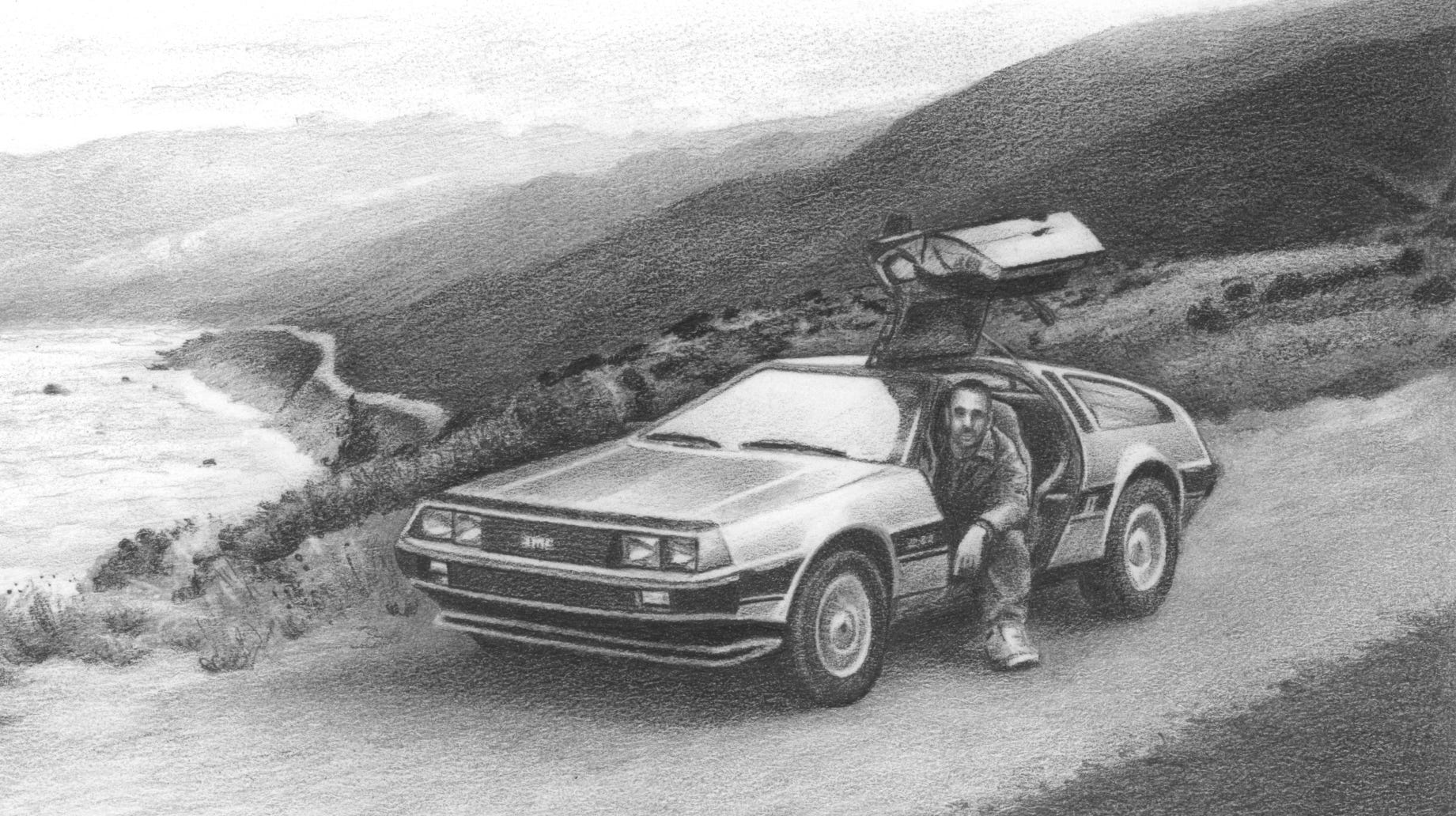
With nothing else to do, Savage drives up the Pacific Coast to Mendocino to meet the inventor from the internet.
This is a work of fiction. Any resemblance to real Jacob Savages or any other persons, living or dead, is purely coincidental.
this is compelling.
I'm in